
141. SPN: How to Decode Intent
Plus, Transferable learnings from Government and AI is a new donor audience to optimize for

A very warm welcome to all the new subscribers.
You’ve joined a community of 2k+ marketing and fund raising operators at mission-driven Org’s. I’m thrilled to have you as readers and truly appreciate your feedback and support.
I’m typing this on a flight heading to Fundraise Up’s Donor Experience Summit (DXS) and hoping to see you there!
Whether or not you’re a client of Fundraise Up (if you want to drive more digital revenue for your Org at some point I’m sure you will be), you should at least join their Community. It’s full of super people doing fantastic things, and they host a great Community Space should you need a desk, or a cup of Barry’s tea.
Follow them on LinkedIn, meet them at Evolve in March or take Diego for a walk when you pop by the office.
Please come and say hi if you’re in Brooklyn this week!

In this week’s SPN →
AI’s perception of your Org will impact your bottom line
Actions drive attitudes, not the other way around
The Holy Trinity: Message, People, Time
How to decode donation intent in ad platforms
Favorite post of the week (Weekly Reads section)
and, plenty of Jobs & Opps that took my fancy this week.
Let’s jump in!
Transferable Learnings from Government
A mate of mine spent 10 years working with the UK Government trying to change behavior with advertising.
Over lunch this week I took a ton of notes but these were the nuggets that stuck:
1. Actions drive attitudes, not the other way around
We assume action follows attitude. We run campaigns to “boost consideration” or “change perceptions.” That often doesn’t work. After years of health-related quit smoking campaigns, he and his team found that making the first step easier - like creating moments when everyone was quitting or providing helpful tools, was far more effective than trying to change attitudes. Important watch out for SPN Operators, brand consideration is often a reflection of penetration - a result of action, not a cause of it.
2. Attitude isn’t the problem
The team once ran an ethnographic study into why people didn’t exercise more. In multiple homes, they found exercise bikes being used to dry clothes and fitness DVDs still in their packaging lol! These people wanted to be fit. Their attitude wasn’t the problem. It was the attitudes of others that mattered more. “If I jog around the estate, people will laugh at me.” What others think is key.
3. Fun + Friends beat Facts + Figures
It's tempting to think that if we just make people aware of the facts, they’ll change their behavior. Nonsense. He consistently found that fun is more powerful than facts, and friends more persuasive than figures, however robust. Instead of pointing donors to a Form 990 (for global readers that’s a tax document all US nonprofit’s have to fill out), should we be creating apps that make it fun and sociable to read it? Or at least make the form itself easier to engage with!?
4. Messenger before message
Running campaigns as the Government isn’t often effective. Other voices do a better job i.e. creating new brands or bringing together a coalition of the concerned. PR and partnerships were a key pillar for them, with advertising playing a support role rather than the other way round. How would your marketing and fund raising plan look if you made that flip?
5. You are not your audience
This nugget tickled me the most. They once talked to a Mom who gave her children lemonade because it was “one of their 5-a-day”. However much you think you understand your audience, you don’t.
Even with UNICEF Kid Power, despite all the data, models and trackers available to us nothing came close to the insights made possible from spending time with people in their own environment. Every ethnographic debrief made me think differently, tracking campaign debriefs rarely did. More difficult at the mass market level but Major Donor fund raisers you have no excuse!
Enhancing Donor Experience, and Vice Versa
My conversations this week suggest AI remains a top priority for nonprofit operators in 2025, with a strong focus on generating tangible results.
Org’s are finding the low hanging fruit. MarTech’s top 50 genAI use cases in marketing is useful - the usual suspects of content creation, production and ideation up top with ad-related use cases struggling to gain traction. Left to right: Usage daily-weekly; monthly; not tried yet; no longer using. Click the image to go to the full infographic.

Hat tip 🎩 to Livestrong for launching Ellis, the first of its kind cancer survivorship companion.
Really interesting and practical example of leveraging AI technology, training it on their rich, verified resources library, and putting it in the hands of those searching for answers.

The metadata Livestrong will be receiving from the questions asked will likely be unbelievably valuable - what are people asking, how are they framing the ask, where are we seeing gaps in our content vs what is being asked? Good use case for how to richly engage supporters onsite too and rethink supporter experience. And I imagine you can put an email capture or donation ask in the flow too.
Another day and another new high performing model - this time Grok3 from Elon Musk. There was some chatter that this didn’t make the headlines it deserved because it’s a Musk project. Fatigue is also real. A new Chinese model called Kimi also launched and also got less attention.
I’m playing in the Answer Engine Optimization space quite a bit at the moment. And coming across some good use cases. Regardless of whether AI is the best donor or the most nitpicky, it may soon become undeniable that an AI’s perception of your Org will have an impact on your bottom line. AI is a new audience. It’s fast becoming the decision maker in the room too.
Are we living through a similar period to early internet years when early adopters were treated to a succession of new browsers, new search engines and new email platforms? And then soon enough the favorites were chosen and nothing much has changed since...
Arguably the key factors then were product features and distribution. All new product innovations were quickly copied, but distribution is key. Much like your core messaging. Google and Chrome, Apple and Safari, Microsoft and Explorer (and Bing). Not everyone won - remember when Amazon launched their own browser Silk and their own search engine A9?
To varying degrees we’re all interested in learning what new models can do but now we’re seeing Joe Bloggs finding use cases for AI in the mainstream. The average user on the street will go with the models with the best distribution and the best User Interface.
One distribution that feels obvious is Voice - but both Amazon and Apple are struggling to evolve Alexa and Siri. Donating through either route hasn’t taken off (yet). Marrying the best product to the best distribution is always a good strategy.
As we say often in SPN, it sure is time to experiment.
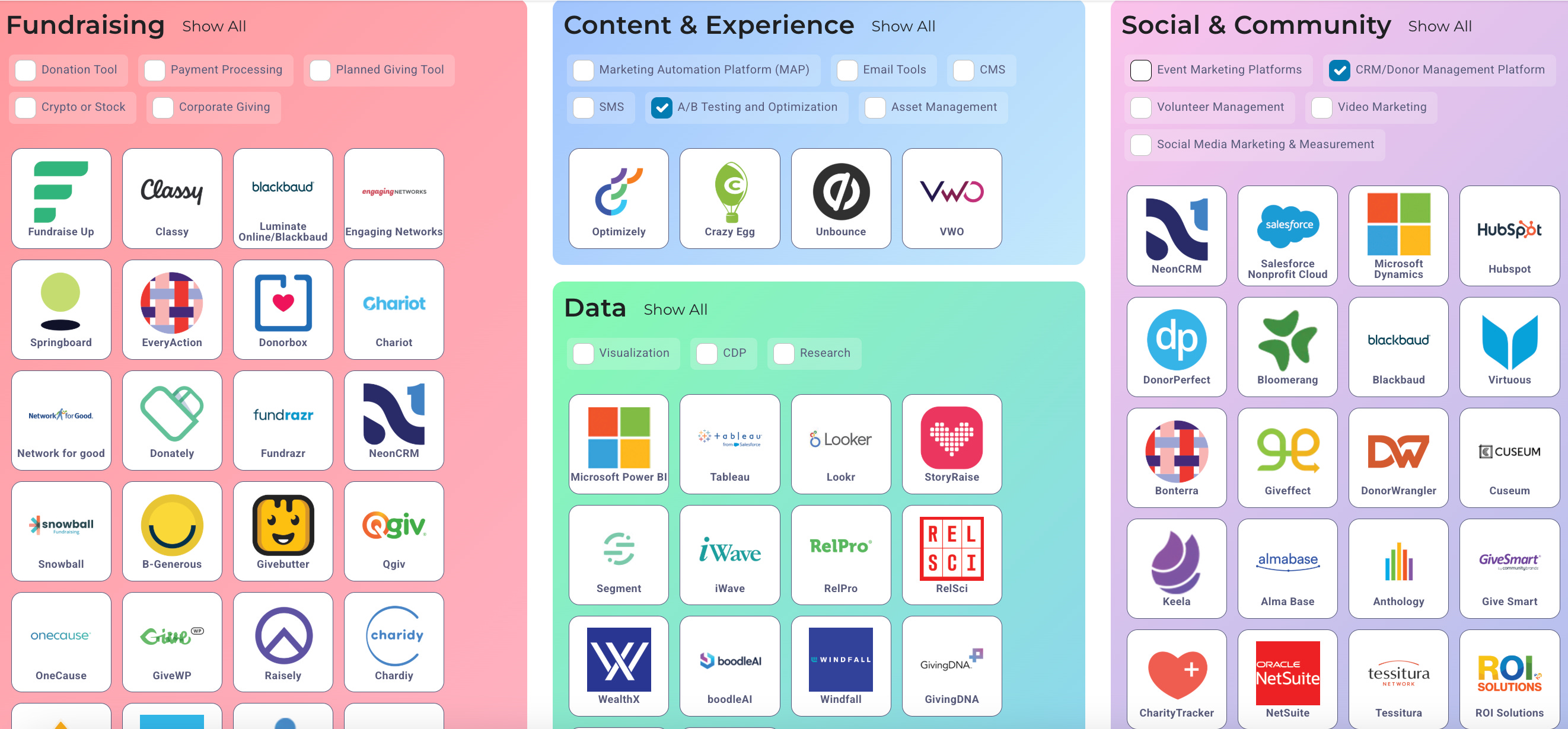
Marketing & Fundraising Technology Landscape (link)
A new section in this infographic is being built for AI tools and platforms.
Send me your recommendations!
Jobs & Opps 🛠️
If you have any jobs that you’d like me to profile please send them to me. There’s a lot of great talent looking for opportunities right now.
American Kidney Fund: Senior Director of Development Strategy and Operations ($165,000 - $180,000)
Rare Beauty (Rare Impact Fund): Director of Communications (up to $150,000)
WWF US: Activism & Outreach Specialist
Campus.org: Executive Director ($100,000 - $130,000)
Coeliac UK: Head of Digital (£48,000 -£55,000)
Please Touch Museum: Chief Growth Officer ($160,000)
International Justice Mission: Global Director, Marketing & Comms
New York Immigration Coalition: VP, Development ($139,050)
YWCA Brooklyn: COO ($125,000 - $150,000)
Global Citizen: Senior Director, Global Marketing ($130,000 - $147,000)
MIND: Head of Digital, Data, & Technology Enablement (£61,595 - £68,139)
ACLU: Director of Affiliate & Advocacy Analytics ($212,836)
→ More jobs and opportunities over at pledgr.com/job-posts
Decoding Donation Intent In Ad Platforms
Since the rise of digital – and more recently, since the fall of 3rd party audience providers - most Org’s rely on look-a-like modeling of current donors to find new ones for acquisition campaigns. Branding aside, P Max, Advantage Plus etc. play a similar role as look-a-like models – but with the added layer of dynamic creative.
While great for most use cases – and for Org’s early on in their digital journey – look-a-likes consistently miss out on recognizing the right time to convert a particular prospect to a first-time donor. These algorithms were never created to consider time – they’re meant to find the right people who look just like your current donors and develop the right messages that resonate most with them.
Adding the right time completes the holy trinity - message, people, time - and makes these campaigns close to invincible.
Here’s how to do it (most of these tips rely on using “bid modifiers” in the platform of your choosing. Don’t create separate campaigns just to split them up by time) →
Never Target Prospects and Donors in the Same Campaign.
As trivial as it sounds, always use the Donor Lifecycle and create separate campaigns for:
Prospects – i.e., exclude everybody who has ever visited the website
Visitors – i.e., target those who visited the website but exclude everybody who has ever donated
One-time donors – i.e., target those who donated once but exclude everybody who has ever donated a second time, that being emergency, monthly, or otherwise
Irregular donors – i.e., target those who donated at least twice but have never signed up for a regular donation schedule
Monthly donors – i.e., target those who have an active, regular donation schedule
Lapsed donors – i.e., target those who had a regular donation schedule but have since canceled it
For segments informed by CRM data only e.g., those with an active vs. canceled monthly donation schedule, set up an automated, bi-weekly email batch upload from your CRM to the custom audience in Google or Meta. → This is a vital step to help your team test into the right time for donors at various stages.
For Each of These Campaigns, “Ideal Time” Has Several Definitions.
Varying by the step in the donor lifecycle, I’ve found several different ways to incorporate an “ideal time” into campaign targeting successfully. Test into these:
“Financial” time, driven by an increase in disposable income – whether permanent or one-time. Especially in paid social platforms (Meta / LinkedIn), set up a bid adjustment to bid higher on people who have started a new job, were promoted, sold their home, or have recently lost their parents and have likely received an inheritance. This trigger applies to all the donor lifecycle groups. Still, I have found the most success with using one-time triggers to convert visitors to prospects and permanent triggers to convert irregular donors to monthly.
“Time of month”, driven by the timing of a paycheck that most donors rely on. Set up modifiers to bid higher on website visitors – to convert them to a first donation - around the mid-month paycheck.
“Time of day,” with considerably fewer conversions happening in the morning versus working hours, evening, or – surprisingly – nighttime. The exact hours for your Org might differ – pull up the Cost per Conversion report for your campaigns, separately for each of the six donor lifecycle stages, and set up your bid modifiers or even exclude some hours altogether. I recommend finding six individual “hours” of the day to exclude and doubling the bid for the other 6 hours.
SPN Tip: Always use the “local” time dimension, not the “account.” In the reports and bid adjustments, separate the hours by weekday and weekend, and you’ll find very different patterns. Surprisingly, the best-performing hours of the day I’ve seen have always been late at night on Friday and Saturday. It’s not the highest volume, but it’s worth increasing the bids and capturing everybody who fits your targeting criteria.
“Recency” at every step of the donor lifecycle. Time since the previous visit to the website, since the last one-time donation, or since lapsing from a regular donation plan. The mechanics of using this dimension are slightly different – create individual audiences within each donor state.
For example, in Google Analytics, build an audience of those who “have signed for the monthly donation within the last 30 days”. In this case use the following time segments:
1 hour
12 hours
1 day
7 days
14 days
30 days
90 days
180 days
For 90- and 180-day segments, use custom email audiences from your CRM instead of Google Analytics or pixel-based audiences. It will allow you to launch campaigns immediately without waiting for audiences to fill in.
Once created, run all the audiences in parallel for a month and run a report, comparing the Conversion Rate before implementing bid adjustments. What I’ve found most of the time is a bell curve-like shape, with 1-14 days segments having the best performance. Act accordingly – increase the bids up to 25% for the best ones and decrease by the same number for the worst ones.
Also, “Frequency” – both the frequency of interactions with the Org and the frequency of Ads.
For the frequency of interactions, implement gradual bid adjustments for every subsequent touch. For example, bid higher on the “visitor” with two website visits than one. The best ratio I found is to increase the bid by 15% for each subsequent interaction, capping it at 2x the bid at six interactions total.
For the frequency of ads, decrease the bid for each subsequent impression by 10% - capping it at 0.5x of your “standard” bid after seven impressions.
Online-Offline Synergies.
If your Org is running direct mail, out-of-home, or digital out-of-home assets, use digital channels as “companion” ads to those channels.
Create a custom audience of those getting a direct mail asset in the mail and increase bids by 25% within 24 hours of the predicted delivery date. Set up bid adjustments based on proximity (select the smallest possible radius) to the OOH/DOOH sites.
Bonus Tip: Intertwine Your Asked-for Amount with Time.
Once you’re through all the bullets above (it’ll take you a few months!), experiment with varying the amount you are asking for with these “right time” triggers.
It’s no different to Uber’s surge pricing. I consistently see a better conversion rate for the “frequency of ads” trigger by reducing the ask after 3-4 unsuccessful impressions. A few ways to combine the two can be:
Time of month – ask for 10% higher than your usual numbers within 2 days of the paycheck dates, and drop to 10% below the typical on the last couple days of the month.
Recency – drop the asked amount by 10% for the 90-day audience compared to the 30-day audience and another 20% for the 180-day one.
Frequency of interactions – decrease the ask gradually by 5% after each interaction without a donation.
Frequency of ads – decrease the ask by ~25% or go from monthly to a one-time after five unsuccessful impressions.
OK, that’s all for today!
I hope you’ve found one nugget today that you can put into play next week.
If you enjoyed this SPN, please consider sharing with your network. Thank you to those that do.
If a friend sent this to you, get the next edition of SPN by signing up below.
And huge thanks to this Quarter’s sponsor Fundraise Up for creating a new standard for online giving.
Weekly Reads
Far and away my favorite post of the week → Why is no one talking about why Duolingo’s social media marketing actual works? (LinkedIn)
Inside The Creativity Debate - How The Rise Of Media And Tech Is Redefining Success (Ad Age)
WTF is open-source marketing mix modeling? (Digiday)
Snapchat playbook (Fospha)
Walmart Is Retail King Again. Can It Keep the Crown? (WSJ)
A new Google Ads Demand Gen Ads video enhancement will let you automatically create short-form videos from existing video ads (Search Engine Land)
AppLovin to become a pure advertising platform (AdExchanger)
Case study: ON (Ana Andjelic)
How Did DeepSeek Build It’s A.I. With Less Money? (NYT)
Adobe’s Sora-Rivaling AI Video Generator Is Now Available for Everyone (The Verge)
The Future Is Solo: AI Is Creating Billion-Dollar One-Person Companies (Forbes)