A very warm welcome to all the new subscribers. You’ve joined a community of over 3k marketing and fund raising operators at mission-driven Org’s. I’m thrilled to have you as readers and truly appreciate your feedback and support.
In this week’s SPN (written while listening to the yet to be releasedDXS 2025 Soundtrack):
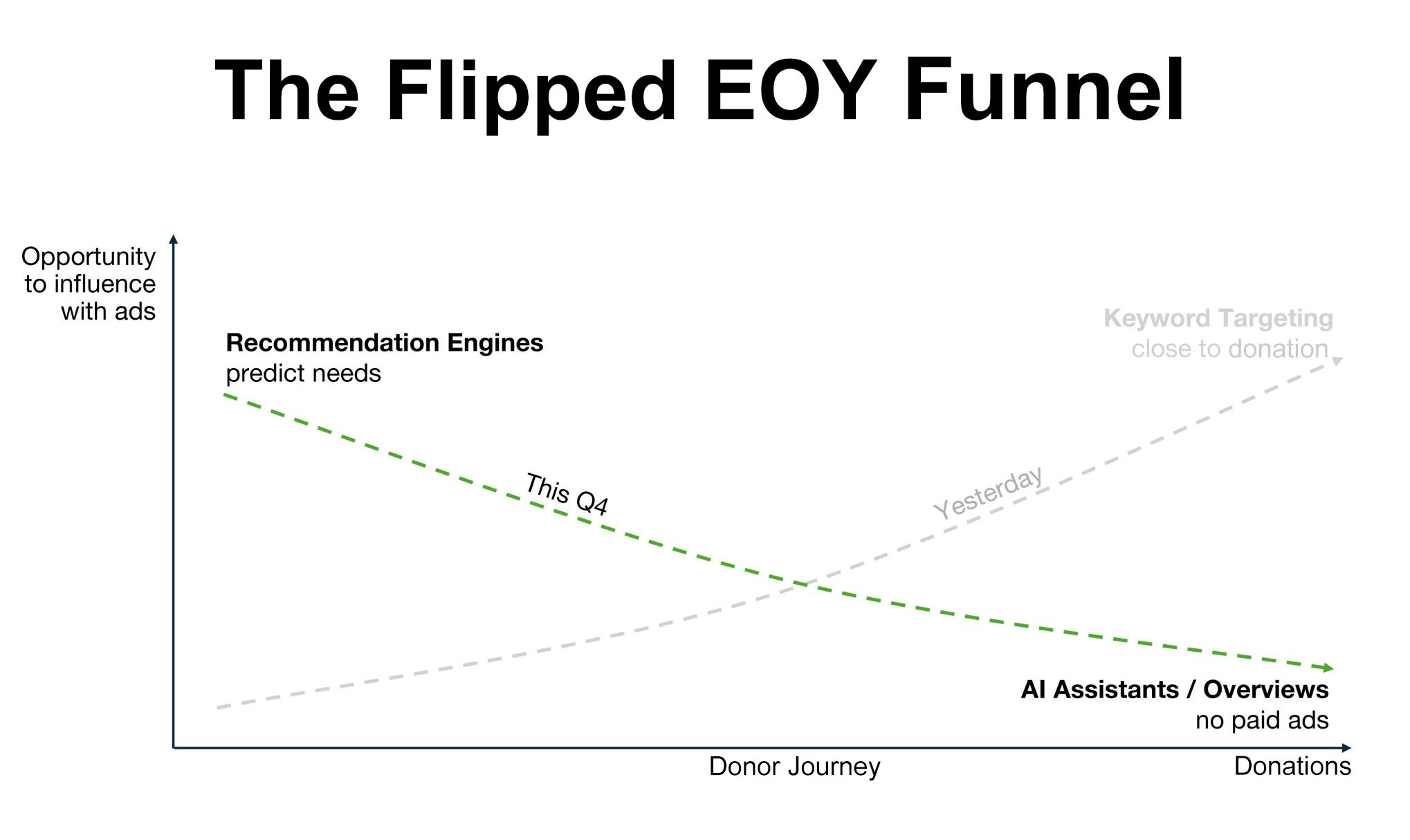
The EOY funnel has flipped → donor search behavior (AI assistants, overviews)
Reels is where it’s at
LTV ROI is a trailing metric
Manage these 7 leading indicators across the donor lifecycle…
And, plenty ofJobs & Opps
Let’s jump in!
✨ MAP International: Donor Experience That Delivers
The switch unlocked MAP’s largest-ever online donation - proof that better donor experiences drive bigger impact.
Talk to Fundraise Up about how they deliver a donor experience that fuels generosity 🚀
Game-changer? It is for me!
EOY Donor Behavior Evolves
For the first time, millions of people will disappear at EOY just before they’re about to give.
Traditionally, the closer someone got to donating, the easier they were to reach with ads and search.
But this EOY will be different:
AI assistants: 18% of people now use them to guide purchase decisions (YouGov).
AI search overviews: referral traffic to websites from search has already dropped 9% (Similarweb).
What this means for Orgs →
The bottom of the fundraising funnel is no longer predictable - it’s wider, murkier, and harder to reach. Meanwhile, the top has become tighter, as algorithms and recommendation engines are better at shaping choices before someone starts searching.
👉 Which makes this year-end unique: It’s harder to influence donors at the end, but easier to inspire them earlier.
How and Where to Flip:
Build mental availability now
Launch EOY brand storytelling campaigns now - make your mission unforgettable before AI is asked the question.
Encourage your leadership team to post thought leadership on LinkedIn, where donor discovery increasingly happens.
Design for recommendation engines
Publish structured content (FAQs, impact stats, clear program pages) that feeds AI and search overviews.
Prioritize YouTube and video content: widely indexed by AI and highly surfaced in recommendation engines.
Control the narrative early
Ensure your Org shows up in trusted third-party sources (Charity Navigator, Wikipedia, news). These are highly cited by AI.
Seed memorable creative in paid and organic channels now so it’s recalled later when giving intent peaks.
Bottom line: If the funnel has flipped, your strategy has to as well - shift spend and storytelling upstream to win when AI becomes the gatekeeper. And get that EOY campaign in-market earlier.
1. DMs are the new social graph 4.5B Reels are shared in DMs every day. Four and a half billion. A day. Private sharing is now the driver of organic reach. Shares matter most.
2. Recommendations → from follows to best of billions 5 years ago: 100% of IG feed was who you follow (0% recommended). Today: 70% is recommended. The gold mine (for IG at least) isn’t “who you follow” anymore, it’s what IG knows you’ll like.
3. Reels is the growth engine This is the format people spend the most time with. Reels is where most recommendations and shares happen, and the rocket fuel of the app. Where’s your Org?
👉 If your Org’s brand strategy is still chasing reach and likes, you’re optimizing for yesterday’s Instagram.
👉 How to audit your funnel and fix the gaps from awareness to retention.
Acquisition costs on Google and Meta are constantly climbing. GA4 is modeled, making analysis of what exactly doesn’t work harder. The first gift rarely yields a return on a cost-per-acquisition basis.
Winning Orgs must plan for lifetime value to grow their digital programs effectively.
The problem is LTV ROI is a trailing metric. You can’t manage it. However, you can manage the leading indicators that contribute to it. The 7 leading indicators across the donor lifecycle that I always tell Orgs to replace “LTV ROI” with:
Viewable CPM. Use cost per 1,000 viewable impressions – for display, use the MRC viewability rule of at least half the ad in view for one second. For video, half the player window in view for two seconds.
I’ve lost donors to basic, annoying, foundational leaks (embarrassingly) at every step of the lifecycle. Here’s a few tactics I’ve deployed to find – and plug – them.
Viewable CPM
Find the leak:
In Google Ads, use the Reach reports and add Viewable impressions and Viewable CTR. In Meta, add the Delivery column set with ThroughPlays, or 3-second views, and Estimated action rate. If Viewable CPM is more than 2x of Average CPM, you are wasting money – get rid of those impressions. Set the alert to monitor your Viewable CPM and highlight any campaigns or ad groups that are 25% or more higher (or lower) than the average – the impression mix is off in them.
In GA4, create a custom report with Sessions by campaign and Average Engagement Time by landing page. Sort in descending order – campaigns driving the worst 10% sessions are not contributing as hard as they should.
Plug the leak:
Add viewability targeting – 50% is the minimum.
Start video creatives with a catchy stat from your Org’s work to increase viewability.
Spread the budget away from the most expensive zip codes if they don’t drive correspondingly higher CVR or Donation Value. Add them back to targeting in December only, when the demand is worth it.
CTR
Find the leak:
In Google Ads, add the Device dimension to your ad report. Most campaigns I’ve seen drive high CTR due to an ungodly high share of Mobile in Display campaigns – don’t let it be over 60%, ever.
In Meta, create a standard report with Placement, Age, and Creative ID dimensions. As basic as it is, I found this combination to be the best way to clean out the worst 10% of your traffic.
Plug the leak:
For CTR, creative is key. I speak at length about creative in almost every episode of SPN – to plug the leak, don’t forget to update assets at least once a week.
A small refresh is enough to drive the algorithms – update the stats, or add more assets to the P Max campaign.
CPC (only applies to Paid Search)
Find the leak:
In Google Ads, look at CPC by match type and query length. One-word generics often inflate CPC without intent – keep your list of negatives up to date.
Plug the leak:
Limit your bids on the upper end and set the alert for any keywords that consistently drive CPCs 30% or more above the account average.
I’ve seen too many campaigns having no upper bound – spending sometimes thousands to get back $20.
CVR to Donation
Find the leak:
In GA4, use the Funnel Exploration report. Define the following steps: Landing Page, Donate Start (event – first click on form), Donate Submit (event – final donation button click). Add breakdowns for Device and Source/Medium, and look at the combinations driving the worst results. Mobile and Display will naturally be on the list – but does anything seem out of pattern? E.g., is Paid Social driving only Mobile traffic – or is a certain channel having an inconsistent drop-off rate, different from all other channels in the same device?
Export the funnel report with all dimensions selected to a CSV file and ask an LLM of choice to list the top three leaks that are showing a consistent pattern. The ones that emerge frequently would be invisible to a human.
Plug the leak:
Test defaulting to monthly for two weeks. Keep it if CVR or revenue per session rises.
Auto-populate a donation form for everybody who spends more than 30 seconds on a landing page.
First Donation Aalue
Find the leak:
Use the on-page analytics on the form – see which buttons donors hover over before clicking one.
Plug the leak:
Increase all default form values gradually, every week. At what point does CVR go down – or hovering behavior change?
Automatically populate higher default amounts for traffic coming from high-intent, high-CVR paid search keywords.
In CRM, cohort out first-time donors by start week and by channel. Use last click if you have to – but ideally, connect to a first-click from GA instead. You can do it by exporting the data from both systems and merging on a Donation ID.
Plug the leak:
Build a day 1, day 7, and day 30 email touchpoints in a “Welcome Journey”. Day one should be a Thank You with no CTA, day seven a video about your Org’s work, and day 30, an invite to a monthly donation with a personal impact story.
Run a monthly donors-only match once per quarter, recognizing tenure. For example, “Your 12th month is matched 5x.”
Share of Regular Donors Staying Beyond Month 12
Find the leak:
In CRM, cohort all regular donors by start month. Define a 13-month survival metric, export the first donation ID, and import it back into your paid media systems to analyze audience dimensions.
Use the same cohort definition to drill down into email program changes month by month – how are those changes affecting the 13-month survival?
Plug the leak:
Design an Anniversary email journey starting at Day 330, with 5-7 touchpoints – moving from recognizing the donor’s impact with no CTA (touches 1-3) to celebrating Org’s achievements in the last 12 months (touches 4-6) to one email asking them to remain a contributor (touch 7).
SPN Pro Tip
Google recently announced MCP server for Analytics. MCP is essentially a “translator” for LLMs to be able to use API calls – and it is an extremely powerful tool. In short, it allows you to connect ChatGPT, Claude, Gemini or any other LLM to your Google Analytics account and use ChatGPT as your analyst.
Start experimenting!
The most powerful insights I was able to find so far are by asking it to compare the data of Orgs I know well to peers mentioned in various case studies buried across the internet.